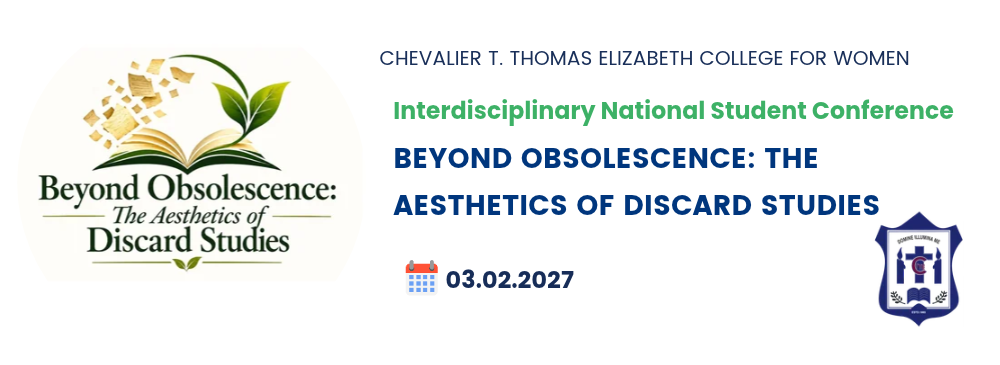

In continuation of the English department’s theme for the current year of highlighting the environmental responsibilities and aligning with the Sustainable Development Goals of the UN, the national interdisciplinary Student Conference also foregrounds the role of the literary imagination in rethinking what we discard and re-reading what we value.
Literature offers a critical space to examine what societies discard, whose histories they erase, and what they choose to preserve. Beyond Obsolescence: The Aesthetics of Discard Studies explores how literary texts transform waste, obsolete technologies, forgotten histories, abandoned spaces, and marginalised lives into sites of cultural and critical inquiry.
Drawing upon Bill Brown’s Thing Theory, particularly his influential essay “Thing Theory,” the conference examines how ordinary objects acquire significance when they cease to function as intended, revealing their material presence, cultural associations, and social histories. It also engages with Susan Signe Morrison’s The Literature of Waste: Material Ecopoetics and Ethical Matter, which offers a critical framework for understanding how literary representations of waste interrogate moral, economic, and ecological structures across historical periods.
Bringing these perspectives into dialogue with ecocriticism, material culture studies, and discard studies, the conference investigates how literature negotiates the shifting notions of value, memory, identity, and exclusion within cultures of consumption and disposability. Through poetry, fiction, drama, life writing, and contemporary narratives, it seeks to examine how literary imagination challenges dominant hierarchies of worth, recovers neglected voices, and reconsiders the relationship between human beings, material worlds, and the environment.
The conference aligns with the United Nations Sustainable Development Goals, particularly SDG 4 (Quality Education), SDG 10 (Reduced Inequalities), SDG 11 (Sustainable Cities and Communities), SDG 12 (Responsible Consumption and Production), SDG 13 (Climate Action), and SDG 16 (Peace, Justice and Strong Institutions), fostering critical consciousness, environmental ethics, social responsibility, and inclusive perspectives
Papers exploring related themes and interdisciplinary perspectives are also welcome.
The Department of English invites undergraduate and postgraduate students and research scholars of all disciplines to submit original research abstracts exploring the literary, cultural, social, and environmental dimensions of obsolescence and disposability.
Bank Name: State Bank of India
Beneficiary Name: C.T.T.E. College
Branch: Perambur, Chennai
Account Number: 10313551041
IFSC Code: SBIN0002256
Address: 1/110, Madhavaram High Road, Perambur, Chennai-11
The registration fee can be paid through NEFT (or) G-pay using the bank transfer option.
Email ID: [email protected]
Honourable Justice . B. Gokuldas
Former Judge , Madras High Court,
Chairman, C.T.T.E. Trust.
Thiru. L. Palamalai I.A.S. (Retd.)
Managing Trustee & Correspondent,
C.T.T.E. Trust.
Dr. S. Sridevi
Professor of English & Principal,
C.T.T.E. College for Women.
Dr. P. J. Queency Asha Dhas
Vice-Principal,
Dean of Research & Assistant Professor,
Department of Corporate Secretaryship,
C.T.T.E. College for Women.
Mrs. Beena Thomas
Associate Professor & Head,
PG Department of English,
C.T.T.E. College for Women.
Dr. M. Priyadarshini
Assistant Professor,
PG Department of English,
C.T.T.E. College for Women.
Dr. B. V. Saraswathy
Assistant Professor, PG Department of English,
CTTE College for Women.