In today’s fast-evolving corporate world, success is driven by the seamless integration of human insight and strategic management. Psychology helps us understand behaviour, motivation and decision-making, while management provides the structure and direction for excellence.
Artificial intelligence is reshaping not only how we work, but how we think, learn and decide. From social media feeds and targeted advertising to investment choices and workplace interactions, AI increasingly mediates human judgment. Consequently, understanding the psychological processes that guide perception and decision-making has become essential from an early age.
Foundational research in behavioural economics has reinforced psychology’s central role in management. Daniel Kahneman revealed that people frequently rely on perceived gains and losses rather than purely rational calculation. Richard H. Thaler highlighted how cognitive biases and choice architecture shape consumer and economic behaviour. Angus Deaton’s work deepened our understanding of how households make consumption and welfare decisions. Together, their contributions show that human judgment is guided as much by psychological forces as by logical analysis.
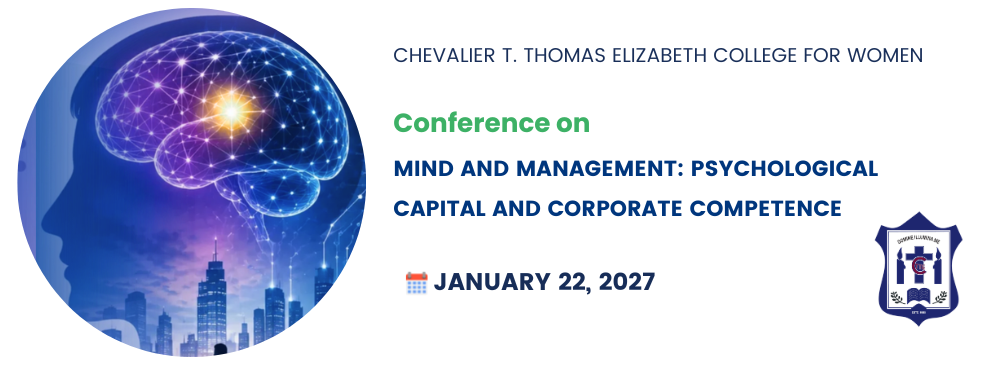
This conference — Mind and Management: Psychological Capital and Corporate Competence — creates a platform to explore these intersections. It invites school students, undergraduates, postgraduates, research scholars, academicians and industry professionals to examine how psychological capital, behavioural science and artificial intelligence interact to influence leadership, consumer behaviour, organisational performance and ethical decision-making.
By fostering interdisciplinary dialogue between educators, researchers and practitioners, the conference aims to cultivate informed, responsible and resilient individuals. Participants will gain insights into both the promise and the psychological challenges of an AI-driven world, equipping them to harness technology while safeguarding humane and ethical management practices.
Research Papers (Qualitative/Quantitative/Mixed Methods, Review Papers, Conceptual Papers, Articles and Case Studies) pertaining to but not restricted to the given themes
The Organizing Committee invites original, unpublished, and high-quality research papers from academicians, researchers, industry professionals, corporate practitioners, research scholars, and students for presentation at the Interdisciplinary National Conference on Mind and Management: Psychological Capital and Corporate Competence
Papers should align with the conference theme or any of the listed sub-themes.
E-certificates will be issued to all registered presenters and participants.
Last Date for Registration: 08.01.2027
The abstract should contain a brief context of the statement of the problem, objectives of the research paper, research methodology adopted, Summarizing the key findings, presenting the implications, recommendations, and scope for future research.
Last Date for Submission of Abstract: 23.12.2026
Notification of Acceptance of Abstract: 30.12.2026
Last Date for Submission of Full Paper: 15.01.2027
Bank Name: State Bank of India
Beneficiary Name: C.T.T.E. College
Branch: Perambur, Chennai
Account Number: 10313551041
IFSC Code: SBIN0002256
Address: 1/110, Madhavaram High Road, Perambur, Chennai-11
The registration fee can be paid through NEFT (or) G-pay using the bank transfer option.
A maximum of 2 authors is permitted per paper
Honourable Justice . B. Gokuldas
Former Judge , Madras High Court
Chairman, C.T.T.E. Trust
Thiru. L. Palamalai I.A.S. (Retd.)
Managing Trustee & Correspondent
C.T.T.E. Trust
Dr. S. Sridevi
Principal
C.T.T.E. College for Women
Dr. P. J. Queency Asha Dhas
Vice-Principal
Dean of Research & Assistant Professor
Department of Corporate Secretaryship
C.T.T.E. College for Women
Dr. Sugin Raj M
Assistant Professor
Department of Management|
Kristu Jayanti Deemed to be University
Bangalore
Dr. D. Janis Bibiyana
Associate Professor & Head
Department of Commerce – PA, ISM & IAF
Faculty of Science and Humanities
SRM Institute of Science and Technology, Ramapuram
Ms. Sunita Chand
Associate Professor of Psychology
D. B. G. Government College
Panipat
Dr. Suresh Reddy Jakka
Assistant Professor, Department of Business Management
Mahatma Gandhi University, Nalgonda
Telangana
Dr. S. Anthony Rahul Golden
Assistant Professor, Department of Commerce
Loyola College (Autonomous)
Chennai
Dr. K. Kanchana
Assistant Professor, Department of Corporate Secretaryship
CTTE College for Women
Phone Number: 9677078402