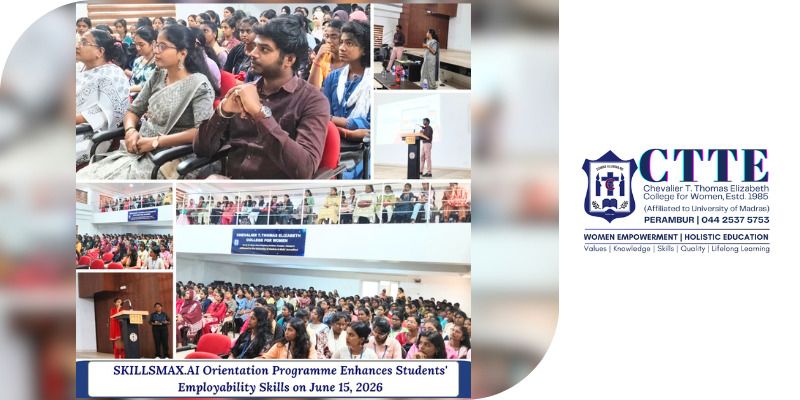
The Placement Cell & Career Guidance Cell of Chevalier T. Thomas Elizabeth College for Women, in collaboration with ICT Academy, organised the SKILLSMAX.AI Orientation Programme on 15 June 2026 from 11.00 a.m. to 12.30 p.m. at the JKK Auditorium.
The programme commenced with a welcome address, followed by an introduction to the resource persons, Mr Rajkumar MP, Senior Solution Consultant, and Ms Meenalosini Boominathan, Client Success Manager. The resource persons provided a comprehensive overview of the SKILLSMAX.AI platform, highlighting its role in enhancing students’ employability through structured learning, assessment, and skill development. They emphasised the growing significance of aptitude, communication proficiency, English language competence, and career readiness in contemporary recruitment processes.
A major highlight of the programme was the live demonstration of aptitude, verbal communication, and English grammar assessments. Students participated in a series of interactive exercises covering grammar, vocabulary, verbal reasoning, and quantitative aptitude. These activities enabled participants to evaluate their existing competencies while gaining valuable insights into the assessment patterns commonly adopted by recruiters and organisations during campus placements.
The session further focused on strengthening communication skills, improving grammatical accuracy, enhancing logical reasoning and problem-solving abilities, and developing interview preparedness. Practical strategies for approaching placement assessments and competitive examinations were discussed, enabling students to better understand employer expectations and recruitment standards. An interactive question-and-answer session provided participants with an opportunity to clarify their queries regarding placements, skill enhancement, and career planning.
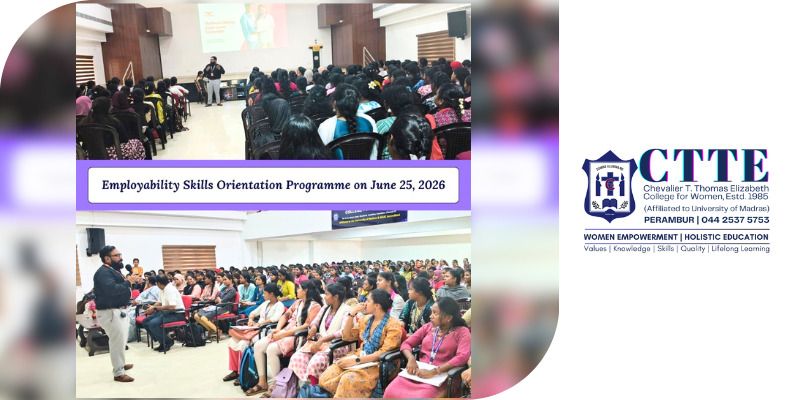
The Placement Cell & Career Guidance Cell of Chevalier T. Thomas Elizabeth College for Women organised an Employability Skills Orientation Programme on 22 June 2026.
The programme commenced with a welcome address, followed by an introduction to the resource person, Mr Mohammed Samiuddin, Ecosystem Head, Wadhwani Foundation. In his address, he emphasised the growing importance of employability skills and job readiness in an increasingly competitive employment landscape. He highlighted that, in addition to technical knowledge, competencies such as effective communication, critical thinking, problem-solving, teamwork, adaptability, and professional ethics are indispensable for achieving long-term career success.
A key highlight of the session was the introduction to the Wadhwani Foundation Job Readiness Programme. The resource person demonstrated the Foundation’s AI-enabled learning platform, showcasing its innovative features, including AI-powered mock interviews, certification programmes, the complimentary AI for Finance course, and comprehensive placement support. He explained how these resources enable students to develop industry-relevant competencies, improve interview performance, and enhance their employability through personalised learning experiences.
The session also focused on interview preparation, professional development, and strategies for building a successful career. Students actively engaged with the resource person through an interactive discussion, raising questions related to industry expectations, career planning, and placement opportunities. The programme provided participants with practical guidance on systematic skill development and the effective utilisation of digital learning resources.
The programme successfully achieved its objectives of creating awareness about employability skills, introducing students to the Wadhwani Foundation Job Readiness Programme, and familiarising them with AI-enabled learning tools and career development resources. The interactive demonstrations and discussions enhanced participants’ understanding of communication skills, professional ethics, interview techniques, and lifelong learning, while increasing their confidence to face recruitment processes.